
Does a Gluten-Free Diet Help Arthritis? What People with Sjögren's Disease Need to Know

Updated: Aug 4
Most people with inflammatory arthritis do not need to avoid gluten. A gluten-free diet is recommended for people with celiac disease and may benefit those with non-celiac gluten/wheat sensitivity, but current evidence does not support eliminating gluten for everyone with rheumatoid arthritis, Sjögren's disease or other forms of inflammatory arthritis. |
By Cristina Montoya, RD — Arthritis Dietitian
Originally published: February 2021
Updated: May 2026, to reflect the emerging evidence on gluten-related disorders and inflammatory arthritis.

If you have rheumatoid arthritis, Sjögren's disease, psoriatic arthritis, or another autoimmune condition, you might have thought about whether cutting out gluten could help reduce inflammation or prevent flare-ups.
It's one of the most common nutrition questions I get as a Registered Dietitian, and one of the most searched topics online.
So, what's the quick answer?
Most people with inflammatory arthritis don't need to avoid gluten.
However, there are some important exceptions, especially if you have celiac disease, non-celiac gluten/wheat sensitivity, or certain digestive symptoms.
In this article:
What is gluten?

Gluten is a group of proteins found in wheat, barley, and rye, specifically prolamin and glutelin.
These proteins give bread its structure, elasticity, and that soft, chewy texture we all recognize and enjoy.
From a culinary perspective, gluten is impressive.
From a health perspective, it’s more nuanced.
For most people, gluten is completely safe. But for others, it can trigger a range of immune or digestive responses.
Not all reactions to wheat are caused by gluten
Before you decide if a gluten-free diet is right for you, remember that not all reactions to wheat are caused by gluten.
Several conditions can cause symptoms after eating wheat-containing foods. While some are true gluten-related disorders, others are caused by different components of wheat or entirely separate gastrointestinal conditions
Knowing these differences can help you avoid cutting out foods you don’t need to and make sure you get the right diagnosis.
1. Celiac disease (autoimmune)
When a person consumes gluten (prolamin and glutelin) found in wheat, rye, and barley, it triggers an immune reaction in the small intestine, causing inflammation and eventually damage.
This damage leads to the body being unable to absorb essential nutrients such as iron, calcium, vitamin D, and folic acid, as well as carbohydrates like lactose and proteins.
Celiac disease affects approximately 1% of the population worldwide. Some symptoms in CD are similar to those in rheumatic diseases, like muscle and joint pain and physical and cognitive fatigue.
2. Non-celiac Gluten / Wheat Sensitivity (NCGWS)
Symptoms occur after eating gluten or other types of proteins in wheat, like amylase trypsin inhibitors, but without the intestinal damage seen in celiac disease.
Symptoms can include bloating, fatigue, brain fog, and even joint pain.
3. Wheat allergy
An IgE-mediated allergic reaction to proteins in wheat. This can cause hives, swelling, or, in severe cases, anaphylaxis.
Wheat can be a trigger for some individuals with Eosinophilic esophagitis (EoE), a chronic immune system disease that causes inflammation of the esophagus, leading to difficulty swallowing and food impaction (choking).
4. Fructan intolerance (often overlooked)
Some people react not to gluten, but to fructans, a type of fermentable carbohydrate found in wheat.
This is part of the FODMAP (Fermentable Oligosaccharides, Disaccharides, Monosaccharides and Polyols) family and is a very common driver of bloating.
This difference matters because a person might feel better after cutting out wheat, even if gluten is not actually causing their symptoms.
For this reason, it is important to get a proper assessment before starting a gluten-free diet.

Should I try gluten-free?
Condition | Gluten-free diet? |
|---|---|
Celiac Disease | ☑️ Yes |
Wheat allergy | ☑️ Yes |
Confirmed NCGWS | ☑️ Often Helpful |
Rheumatoid Arthritis without CD or NCGWS | ❌ Not routinely recommended |
Sjogren's disease without CD or NCGWS | ❌ Not routinely recommended |
IBS | 🤔 Investigate FODMAPs first |
Thinking about going gluten-free?
Download your free Gluten-Free & Low FODMAP Breakfast Recipe Bundle
and join my newsletter for evidence-based nutrition tips delivered to your inbox.
Can gluten trigger arthritis flares?
Here’s the honest answer:
There is insufficient scientific evidence to support eliminating gluten in people with arthritis unless they have celiac disease or non-celiac gluten/wheat sensitivity.
Is there a connection between gluten and inflammatory arthritis?
The autoimmune overlap
Autoimmune diseases tend to cluster. So, it’s not uncommon to see overlap between:
Celiac disease
Rheumatoid arthritis
Sjögren’s disease
Autoimmune thyroid disease
Diabetes type 1
The gut–joint connection
In people with celiac disease, gliadin triggers an immune response in the small intestine. Therefore, emerging research suggests that this intestinal immune activation, together with changes in the gut microbiome and intestinal barrier, may contribute to systemic inflammation through the gut-joint axis.
However, this mechanism is still being studied and does not explain all forms of inflammatory arthritis.
Learn more about how the gut microbiome may influence autoimmune diseases in my article on Gut Health, Inflammation Sjogren's and Arthritis.
Why do some people feel better without gluten?
Many people misunderstand the connection between gluten and arthritis.
If you felt better after trying a gluten-free diet, it does not always mean gluten was causing your symptoms.
There are a few reasons you might feel better:
Some people have celiac disease or are sensitive to gluten or wheat. For them, cutting out gluten or wheat can help reduce symptoms.
You might actually be reacting to fructans, which are a type of carbohydrate found in wheat, rye, and barley, instead of gluten itself.
You could have irritable bowel syndrome (IBS). Many people with IBS are sensitive to fructans, so eating less wheat can help with bloating, stomach pain, and changes in bowel habits.
Your overall diet might have improved. People who go gluten-free often eat less ultra-processed foods and more whole foods like fruits, vegetables, beans, fish, and gluten-free grains.
You might also be cooking more at home, which can help you eat fewer highly processed foods that are often higher in sodium, saturated fat, and added sugars.
The main point is that feeling better on a gluten-free diet does not always mean gluten was the issue.
Instead of wondering which foods to eliminate next, focus on building an eating pattern that nourishes your body sustainably. Explore my blog on the Anti-Inflammatory Diet for Sjögren's Disease to learn how to support your health without unnecessary restrictions.

Sjögren's disease and gluten: is there a stronger connection?
Individuals with Sjögren’s disease have a higher prevalence of Non-Celiac Gluten/Wheat Sensitivity (NCGWS) and Celiac Disease than the general population.
There may be common genetic markers and overlapping symptoms, but this does not mean everyone with Sjögren's should avoid gluten. Testing is recommended before removing gluten from the diet.
Symptoms of NCGWS, such as mucosal dryness, joint pain, and fatigue, overlap significantly with those of Sjögren’s, which may complicate diagnosis and management.
Additionally, a recent study based on questionnaires indicated a connection between Sjögren’s without related autoimmune diseases (formerly referred to as primary Sjögren’s syndrome), where almost half (47.6%) of the surveyed pSS patients self-reported non-celiac wheat sensitivity (NCWS).
However, because these outcomes relied entirely on self-reported questionnaires rather than clinical confirmation tests, the results must be viewed with caution, as self-reporting can introduce participant bias.
Before going gluten-free, ask yourself these questions
Have I:
been tested for celiac disease?
ruled out wheat allergy?
been assessed for IBS or SIBO?
considered FODMAP intolerance?
Could something else be causing your symptoms?
Not every digestive symptom is caused by gluten. In fact, several gastrointestinal conditions can closely mimic the symptoms of CD and NCGWS.
That's why it's imperative to work with your healthcare provider to explore other possible causes before making major dietary changes.
Some of these conditions include:
Inflammatory bowel diseases (IBD), such as Crohn's disease and ulcerative colitis
Microscopic colitis
Functional gastrointestinal disorders, including functional dyspepsia
Irritable bowel syndrome (IBS) or small intestinal bacterial overgrowth (SIBO)
Bile acid malabsorption diarrhea
Exocrine pancreatic insufficiency (EPI)
Dyssynergic defecation, a pelvic floor disorder that affects bowel movements
Many of these conditions can cause symptoms such as bloating, abdominal pain, diarrhea, constipation, nutrient deficiencies, and fatigue.
Those symptoms often overlap with gluten-related disorders, so identifying the underlying cause is the first step toward choosing the most effective treatment.
Because several gastrointestinal conditions share similar symptoms, a careful medical evaluation is often more helpful than eliminating foods based on symptoms alone.
Beyond wheat, rye and barley: how to spot hidden sources of gluten
Gluten shows up in more places than you might expect:
Wheat (including spelt, farro, semolina)
Barley (malt, beer, malt vinegar, Rice Krispies squares)
Rye crackers
Processed foods (soups, sauces, cereals, snack bars)
Soy sauce and tempura
Chocolates or flavoured products

Don’t remove gluten before testing
This is one of the biggest mistakes I see.
If you feel that gluten is triggering symptoms like fatigue, joint pain, dryness, digestive symptoms or suspect celiac disease, do not start a gluten-free diet before testing.
Why?
Because removing gluten can lead to false negative results, making diagnosis more difficult.
What is a gluten challenge and when should I do it?
A gluten challenge involves reintroducing gluten into your diet before testing for celiac disease. This step is essential for an accurate diagnosis.
You may need a gluten challenge if:
You’ve been experiencing symptoms linked to gluten-related disorders
You’ve been gluten-free for several weeks (typically more than 6–8 weeks)
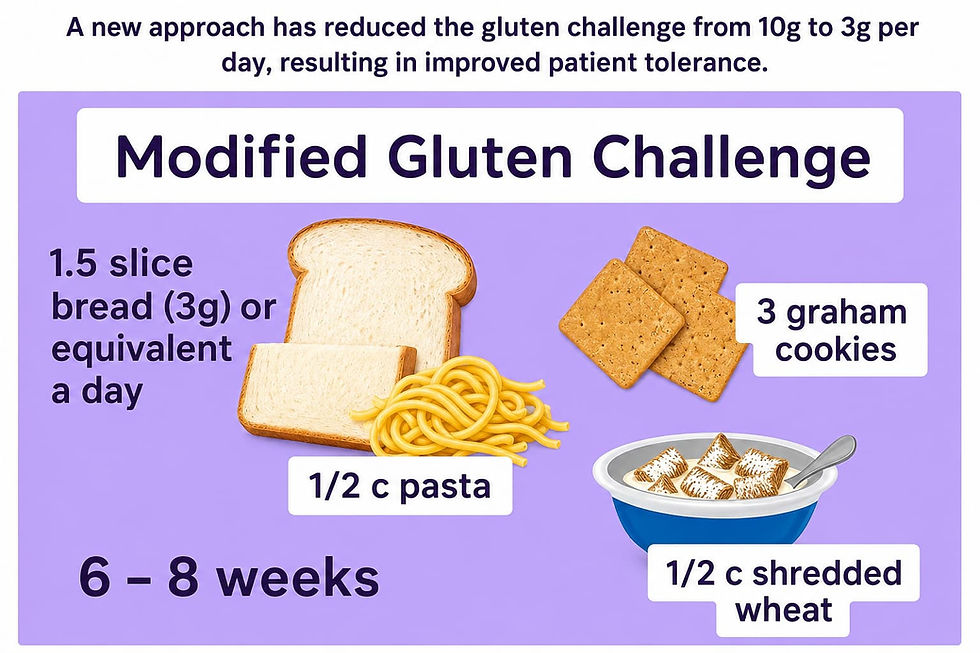
How much gluten is needed?
To get reliable results, gluten needs to be consumed consistently before testing.
Traditional recommendations: 3–10 grams of gluten per day for 8 weeks
More tolerable approach: ~3 grams per day for 6–8 weeks
This lower-dose approach has been shown to improve tolerance while still allowing for accurate testing and helps avoid committing to a lifelong gluten-free diet without knowing whether gluten is truly the cause of your symptoms.
What about genetic testing?
In some situations, your healthcare provider may recommend HLA genetic testing.
A negative result can effectively rule out celiac disease, but a positive result does not confirm the diagnosis. The test only indicates genetic risk.
10 safety tips for individuals with Celiac Disease or Non-Celiac Gluten/Wheat Sensitivity on a gluten-free diet
1. Stick to a strict gluten-free diet; avoid all foods and products containing wheat, barley, rye, and their derivatives.
2. Check food labels for hidden sources of gluten. Look for gluten-free certification on packaged foods.
3. Avoid cross-contamination in the kitchen. Use separate utensils, cutting boards, and toasters for gluten-free foods.
4. When eating out, call the restaurant in advance and inform the staff about your gluten-free needs. Ask about ingredients and food preparation methods to ensure no cross-contamination.
5. Ensure a balanced and nutrient-rich diet by including naturally gluten-free foods like fruits, vegetables, lean proteins, and gluten-free grains (e.g., quinoa, rice).
6. Schedule regular check-ups with your healthcare provider to monitor your health and nutritional status.
7. Stay informed about celiac disease and educate family, friends, and caregivers about your dietary needs.
8. Consult with a Registered Dietitian to assess the need for supplements, especially iron, folic acid, B12, calcium, and vitamin D.
9. Connect with support groups for emotional support and practical advice.
10. Be aware of labelling like “gluten friendly,” “gluten smart,” “gluten aware.” When in doubt, leave it out!
Frequently Asked Questions
Q: Does a gluten-free diet mean "healthy"?
No. Many commercial gluten-free products fall into the "processed food trap," being lower in fibre and higher in sugar or sodium than their gluten-containing counterparts.
Q: Does a gluten-free diet cure autoimmune disease?
No. It is a management tool, not a cure. The priority should remain on overall anti-inflammatory patterns like the Mediterranean diet.
Q: How can I identify high-quality gluten-free foods?
Prioritize naturally gluten-free whole grains like quinoa, brown rice, or buckwheat over highly processed "substitute" products.
Can I have celiac disease without digestive symptoms?
Yes. Some people present with fatigue, iron deficiency, osteoporosis, neurological symptoms, infertility, or joint pain, while others have few or no gastrointestinal symptoms. This is one reason testing is recommended before starting a gluten-free diet if celiac disease is suspected.
Key Takeaways✔️ Most people with arthritis do not need to eliminate gluten. ✔️ Gluten-free diets are essential for people with celiac disease and may help those with non-celiac gluten/wheat sensitivity. ✔️ Many people reacting to wheat may actually be sensitive to fructans, a type of FODMAP. ✔️ If you suspect gluten is affecting your symptoms, get tested before removing it from your diet. ✔️ Focus on an overall anti-inflammatory eating pattern rather than eliminating foods unnecessarily. |
My take as a registered dietitian living with RA and Sjögren's Disease
As someone living with both rheumatoid arthritis and Sjögren's disease, I understand the desire to find foods that reduce flares. But after years of working with individuals with autoimmune diseases, I've learned that there isn't one food responsible for everyone's symptoms.
My goal is never to help you remove more foods than necessary. It's to help you understand your symptoms, nourish your body, and build an eating pattern that's both evidence-based and sustainable.
Explore my personalized nutrition support programs.
Download my Gluten-Free & Low FODMAP recipe collection
Trying to figure out what to eat can feel overwhelming, especially if you've recently been diagnosed with celiac disease, non-celiac gluten/wheat sensitivity, or you're exploring whether FODMAPs may be contributing to your digestive symptoms.
I've created a collection of gluten-free and low FODMAP breakfast recipes to help you nourish your gut without sacrificing flavour.
Download My Free Gluten-Free & Low FODMAP Breakfast Recipe Bundle
and join my newsletter for evidence-based nutrition tips delivered to your inbox.
In this webinar organized by Arthritis Society Canada, I discussed all aspects of gluten-related disorders and arthritis.
References
Bartoloni, E., Bistoni, O., Alunno, A., et al. (2019). Celiac disease prevalence is increased in primary Sjögren's syndrome and diffuse systemic sclerosis: Lessons from a large multicenter study. Journal of Clinical Medicine, 8(4), 540. https://doi.org/10.3390/jcm8040540
Biesiekierski, J. R., Jonkers, D., Ciacci, C., & Aziz, I. (2025). Non-coeliac gluten sensitivity. The Lancet, 406(10518), 2494–2508. https://doi.org/10.1016/S0140-6736(25)01533-8
Lebwohl, B., & colleagues. (2024). Celiac disease and non-celiac enteropathies. Current Opinion in Gastroenterology, 40(6), 421–429. https://pmc.ncbi.nlm.nih.gov/articles/PMC11450258/
Ludvigsson, J. F., et al. (2025). Coeliac disease: Complications and comorbidities. Nature Reviews Gastroenterology & Hepatology, 22, 252–264. https://doi.org/10.1038/s41575-024-01032-w
Maleki-Fischbach, M., et al. (2024). Manifestations and management of Sjögren's disease. Arthritis Research & Therapy.
Skodje, G. I., et al. (2018). Fructan, rather than gluten, induces symptoms in patients with self-reported non-celiac gluten sensitivity. Gastroenterology, 154(3), 529–539.e2. https://doi.org/10.1053/j.gastro.2017.10.040
Størdal, K., & Kurppa, K. (2025). Celiac disease, non-celiac wheat sensitivity, wheat allergy – Clinical and diagnostic aspects. Seminars in Immunology, 77, 101930. https://doi.org/10.1016/j.smim.2025.101930
Helpful resources:


Comments